The government and its partners are piling resources into protecting coastal communities from recurring catastrophes
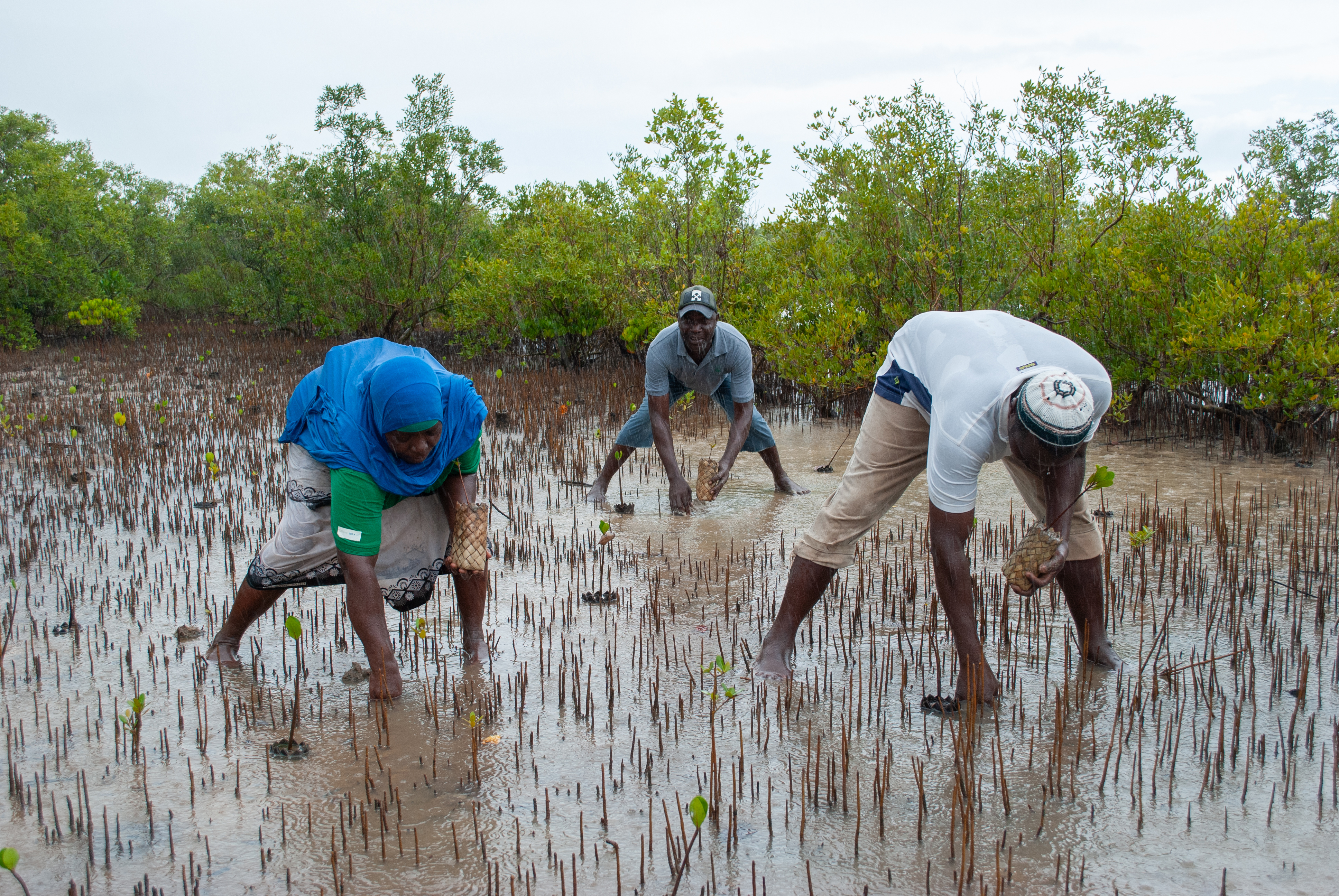
Muanema Timam (in blue) and other volunteers in the Community Fisheries Council of Namau, planting mangroves in the pouring rain. The Council is restoring mangrove forests in the area as well as promoting livelihoods to strengthen resilience against climate change.
As the rain pours down, Muanema Timam digs a hole in the watery sand and plants another mangrove seedling. Her cobalt blue veil is drenched, but there is work to do.
With air and ocean temperatures rising, deadly cyclones and flooding are overwhelming entire districts across Mozambique, including her community in Namau, a small fishing village.
While there are some climate change adaptation projects – like planting mangroves – the government’s resources are being stretched thin by aid cuts, and whether enough is being done to shield the population from recurring catastrophes is an open question.
“When the storm started,” says Timam, “there was an unusual sound. The roof was shaking. I ran to take shelter in my neighbour’s house with my husband and children.”
She is remembering cyclone Chido, which struck her province, Cabo Delgado, in December 2024. When the storm was over, she returned to her house and found it was gone. In a matter of minutes, she says, her life had disappeared.
Situated 1,500 miles north of the capital Maputo, Cabo Delgado is historically marginalised and consistently ranks amongst the poorest and most vulnerable provinces in Mozambique.
Since 2017, the province has been torn apart by an Isis-linked insurgency, forcing 1.3 million people to flee their homes, according to provincial authorities.
Then there’s climate change: in this region, cyclones are another source of terror.
Metacani village, on the coastline of Mecufi district, was almost completely blown away by Chido. Only the strongest houses remain standing, though many have been stripped of their roofing and now lie abandoned. The water tower collapsed. Large trees lie awkwardly where they fell, their bare branches twisted in rigor mortis.
Fernando Neves, a local administrator, says 95 per cent of all the houses in the district, some 14,000 homes, were “completely destroyed”.
For hundreds of villages along the Mozambican littoral, cyclones pose an existential threat. Mozambique’s national meteorological institute has observed that over the last 70 years, the frequency of these massive storms hitting the country from the Indian Ocean has been increasing. Mozambique is likely to experience both stronger category 4-5 tropical cyclones and more frequent and intense rainfall, according to the Intergovernmental Panel on Climate Change.
The government and its partners are racing to help communities adapt. Following the floods in 2000, which killed 800 people, Mozambique developed a national strategy on disasters. Donors reportedly disbursed $480 million (£358 million) towards strengthening the country’s capacity to manage cyclones, floods and droughts. Since then, amongst other responses, Mozambique developed a much more robust national early warning system to prepare for these dangers.
Evidence of this appears in a demonstration by Agostinho Severino and his disaster management committee in Namuapala.
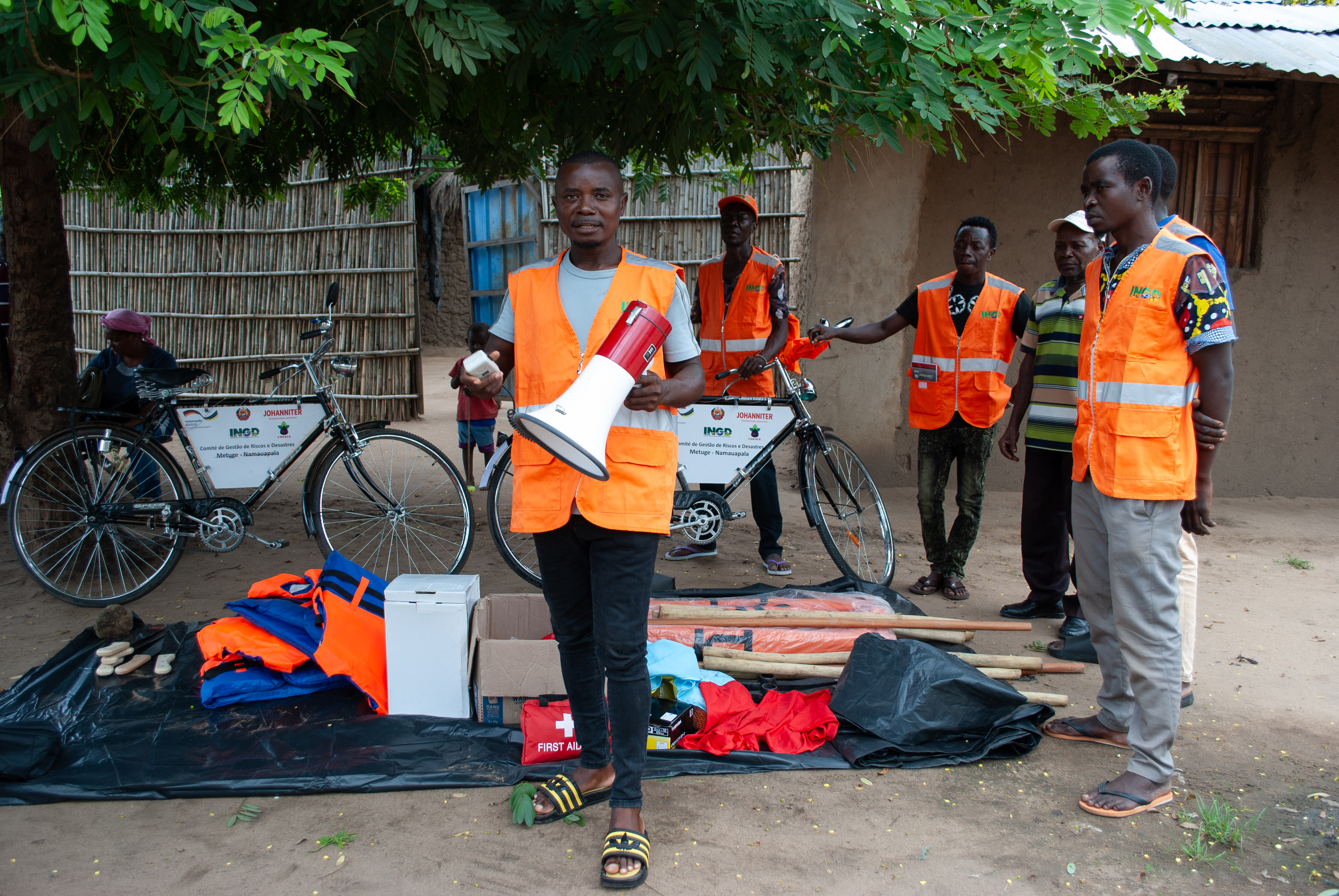
Agostinho Severino, holding a megaphone, with other members of the Committee for Managing Risks and Disasters, in Namuapala village. Across the country similar teams, operating under the National Institute for Disaster Management, are helping communities prepare for cyclones and flooding.
When cyclone warnings air on the radio, the team raises colour-coded flags in village centres. A red flag means the cyclone is arriving that day. Volunteers then cycle through villages with a megaphone, urging residents to take shelter. Operating under the National Institute for Disaster Management and Reduction, these voluntary groups exist across the country.
Mangroves are another pre-emptive measure.
“The mangrove forests act as a barrier to the wind,” says Asani Armiye, leader of the Bandar village community fisheries council. “They protect around a quarter of the village.”
The council has been protecting and planting mangroves in the area for 20 years.
We walk over the sandy estuary to inspect a nursery. Between our footprints, fiddler crabs scuttle over the sand.
Community-led mangrove forestry in Cabo Delgado is being supported by the Aga Khan Foundation.
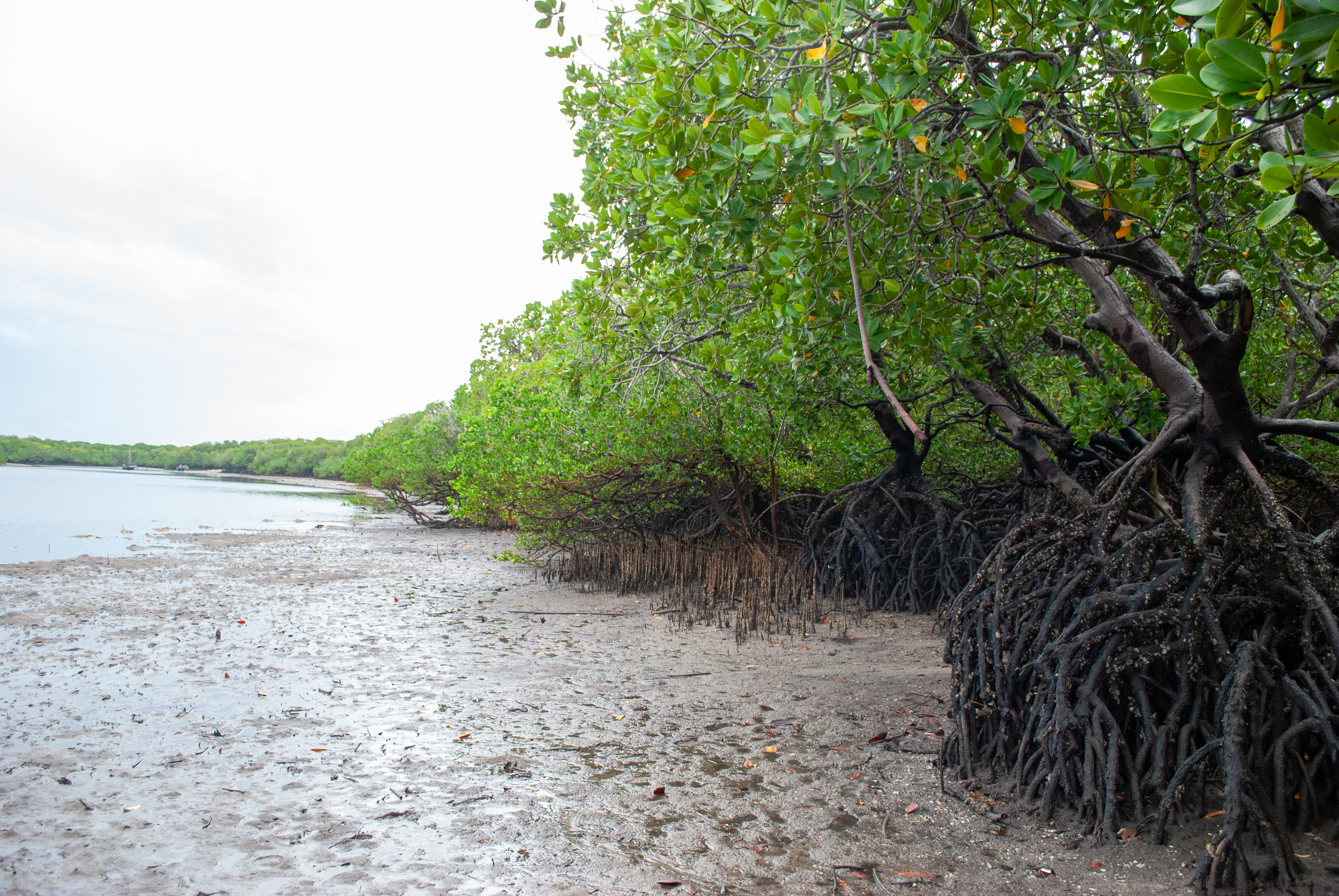
Mangroves growing along the coastline near Namau, Cabo Delgado province, northern Mozambique.
As well as becoming a buffer against the wind, mangroves sequester nearly nine tonnes of carbon dioxide per hectare each year.
Mangroves are also used as hives for bees and their waterways become breeding grounds for fish – vital livelihoods for Mozambique’s coastal communities.
The International Institute for Sustainable Development and UNEP are delivering similar activities in three central and southern estuaries: Bons Sinais, Zambezi, and Limpopo.
In Impire, a Norwegian Refugee Council project is addressing the effects of both the insurgency and cyclone Chido.
The village is a hive of activity: Hundreds of people are registering for aid. Sheets of pristine corrugated iron are being unloaded from a truck.
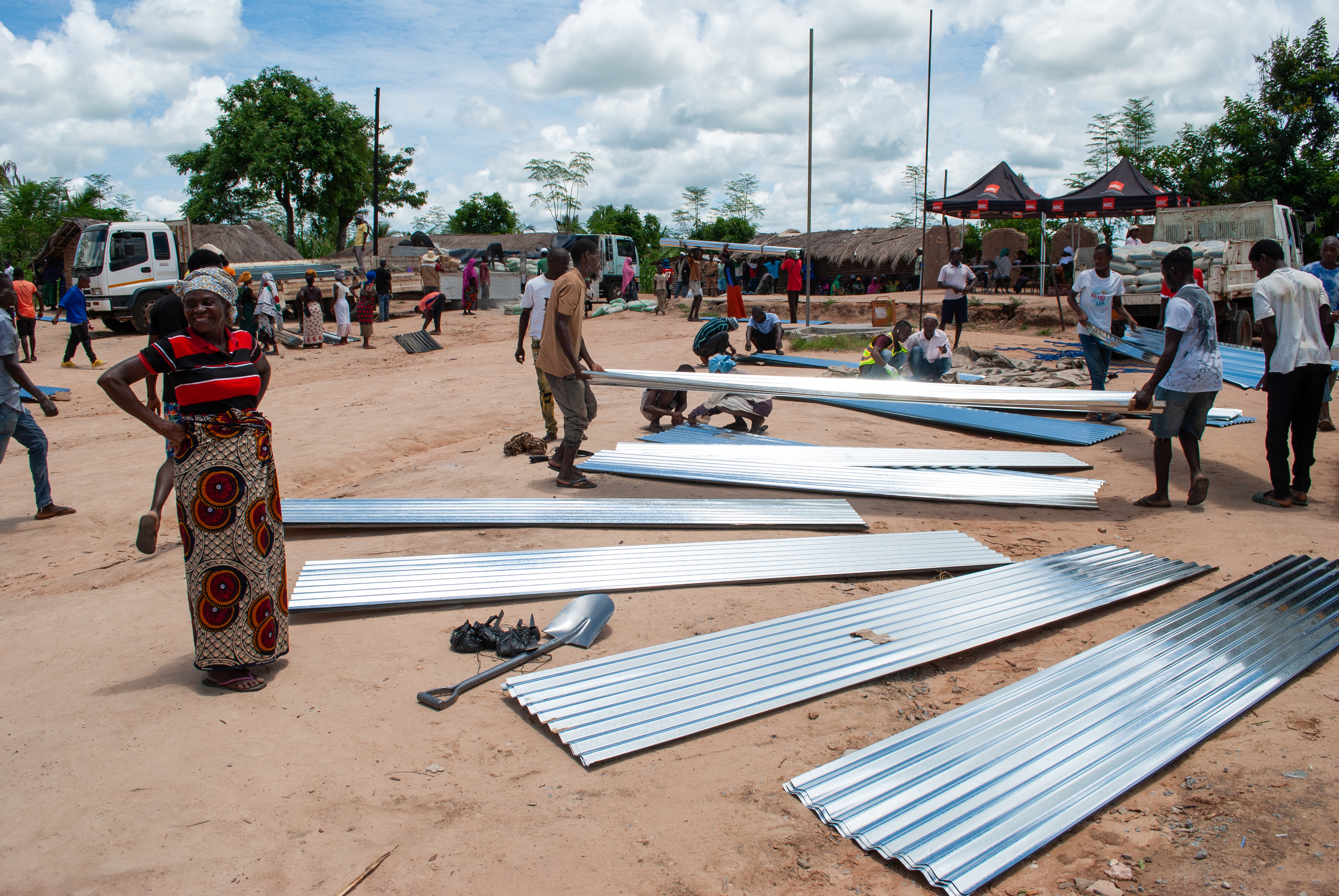
Sheets of corrugated iron being laid out in Impire village. These items are part of a package of assistance provided by Norwegian Refugee Council, which is helping communities respond to the challenges posed by the ISIS-linked insurgency in Cabo Delgado as well as the effects of cyclones.
Iron roofs are more robust against cyclones. But they can be lethal. Raging 150 mph winds tear them off houses and they have been known to kill children caught out of shelter.
Throughout Cabo Delgado there is a lack of resilient housing and infrastructure, though the situation is improving.
In Natuko, white USAID-branded tarpaulins are strapped over parts of the thatch roofs, resembling giant plasters.
But its health centre has been rebuilt with help from Swiss charity Helvetas. Positioned to minimise exposure to high winds, it also has fortified beams to secure the roof.
In Chokwe district, meanwhile, UN-Habitat, the UN’s agency promoting sustainable urban development, is building climate-resilient infrastructure to relieve flood risks.
It has helped to construct a cyclone shelter and radio station that are both raised on stilts. These offered support to some of these tens of thousands left homeless in January this year.
In Beira city, too, the World Bank has been supporting numerous infrastructure projects aimed primarily at protecting the population from floods.
But it is not enough. For Muanema Timam, and others like her who live in these coastal communities, piecing a life back together is one thing, but living in a state of constant vulnerability is another.
With each massive cyclone here, people can lose their homes – like snakes and ladders, they go back to square one. For some, it’s worse – they will lose loved ones.
Timam digs another hole in the sand. The rainy season is here and there is much still to do.
This article was originally published in The Telegraph on 20 March 2026.

 harryjohnstone