The Role of Civil Society in Mozambique
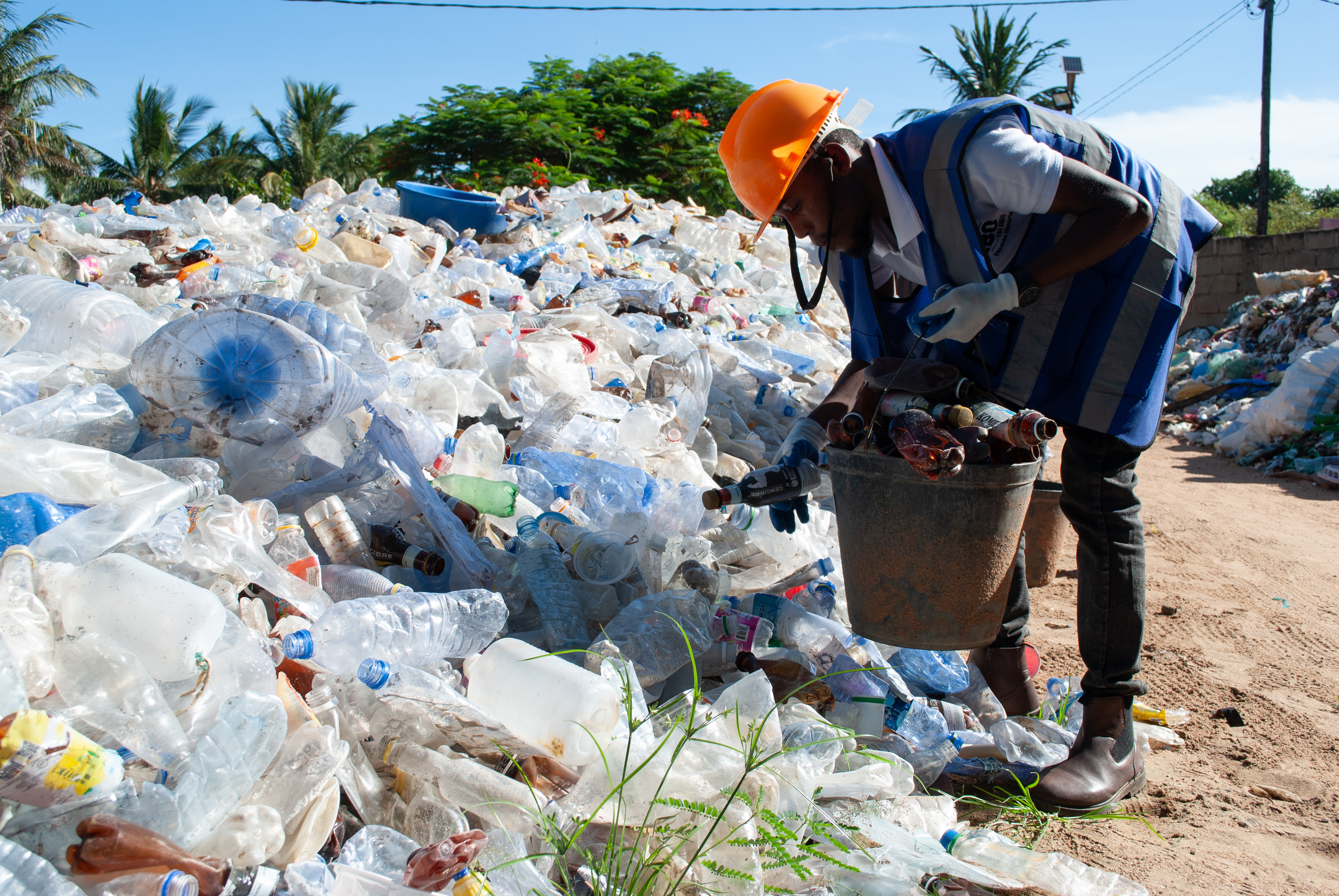
An ASMOG employee selecting plastic waste in front of the ASMOG offices, Pemba, northern Mozambique. ASMOG collects around 10 tonnes of rubbish in Pemba each month.
Marques Joao steps uneasily over the pile of plastic which extends like a glacier in front of his work building. Searching for little brown bottles, he picks them out, fills his bucket, then descends the morass. Joao works for ASMOG, an NGO operating in Cabo Delgado province, northern Mozambique, whose mission is to gather plastic waste and sell it to recycling companies.
‘The government doesn’t recycle or sell plastics,’ says Eugidio Gobo, who leads ASMOG in Pemba. The Pemba municipality generates around 130 tonnes of plastic each month. ASMOG collects about 10 tonnes during that time, mostly off beaches. It is filling a gap. But it operates in a context that is extremely challenging.
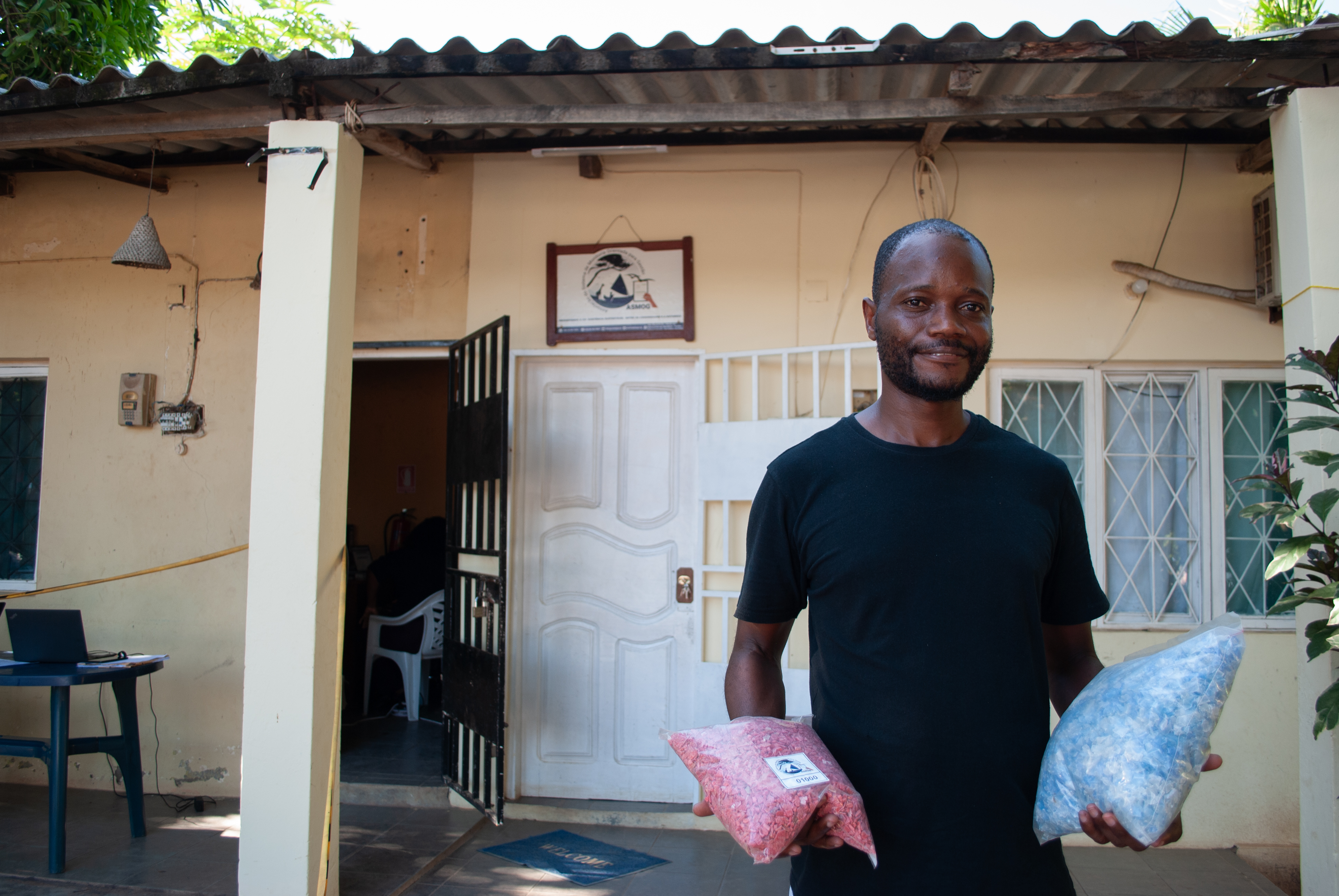
ASMOG coordinator for Pemba, Eugidio Gobo, holding packs of processed plastic in front of the ASMOG office, Pemba. ASMOG collects around 10 tonnes of rubbish in Pemba each month.
Located 1,500 miles north of Maputo, Cabo Delgado is one of Mozambique’s poorest regions, with higher illiteracy and infant mortality rates alongside scarce public services. Cyclones, intensified by climate change, batter the province annually. And an ISIS-linked insurgency has torn it apart, displacing 700,000 people since 2017. As needs grow, aid is shrinking. In this environment, civil society organisations (CSOs) are vital. But they must be positioned to operate sustainably.
‘I feel like our feet are being cut,’ says Abdul Tavares, who works for CDD, a democracy and rights-focused organisation currently being squeezed by aid reductions. ‘We were funding business cooperatives, legal assistance and advocacy on public policy. Without resources, none of these activities are possible,’ he says. CDD recently downsized to a smaller office in Pemba.
Globally, Mozambique is one of the countries most affected by international aid cuts. Reports indicate that U.S. funding alone was slashed from US$ 820 million in 2024 to US$ 240 million last year. While humanitarian assistance is diminishing, other sectors are even more vulnerable.
‘USAID was providing a lot of support to 25 de Junho,’ says Bashiruna Bakar, referring to his village in Cabo Delgado. ‘The assistance was focused on healthcare, farming and food,’ he says. But that was before. Now, this aid has gone. ‘The farmers are crying,’ says Bakar. ‘There is no food.’
But walking towards the edge of his village, Bakar finds cause for optimism. He points to a solid grey house made of breeze blocks. ‘This is a sign of development’, he says. The house is owned by one of the 9,000 internally displaced people (IDPs) who have settled in this village. It is evidence of both inclusion and prosperity.
‘Three months after the displaced people arrived, the farmers gave them land,’ says Bakar. This decision, to maintain stability, was made through the 25 de Junho Village Development Organisation (VDO). ‘We discussed not identifying people on religious or political grounds. Just on our common humanity,’ he says.
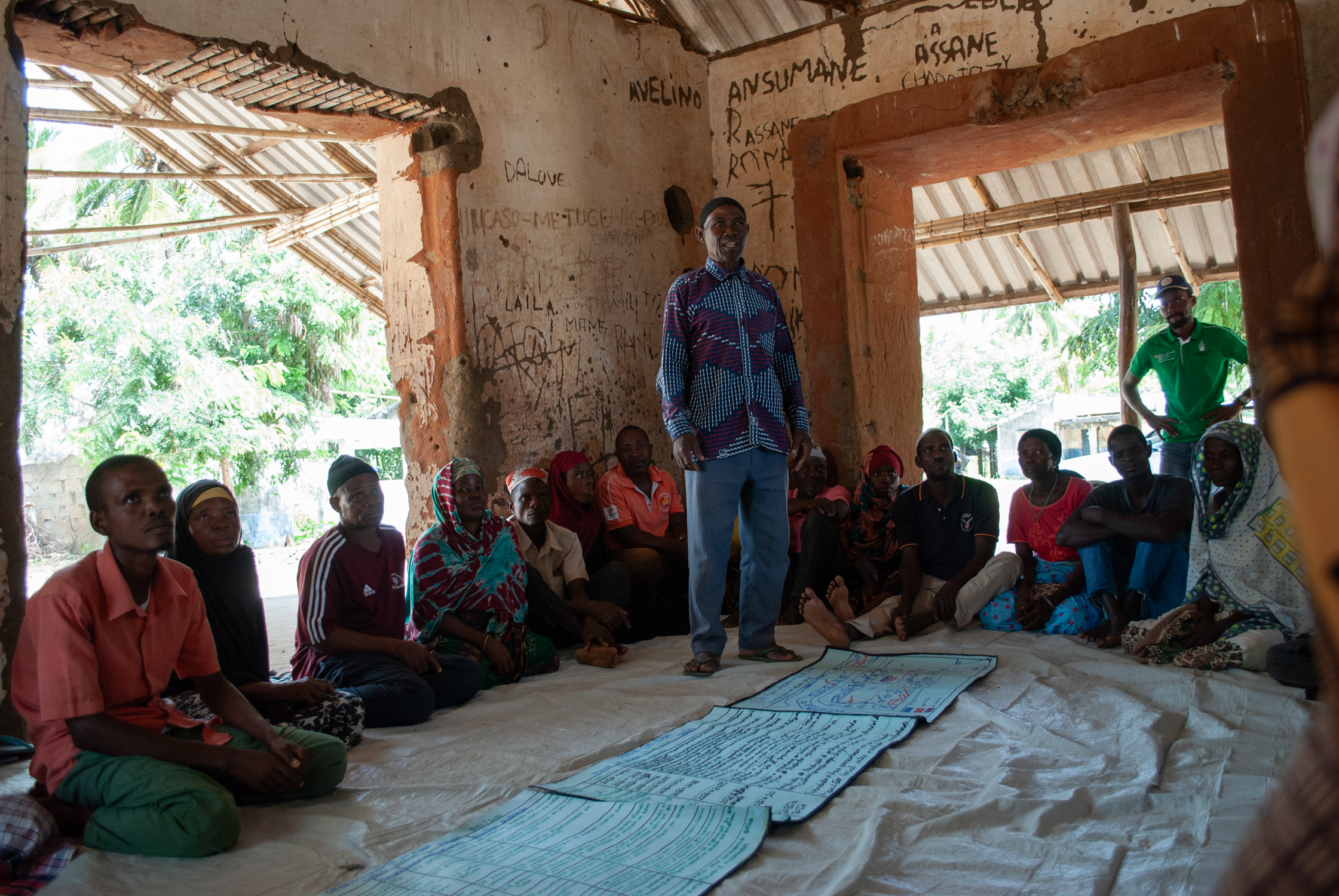
Community leader Bashiruna Bakar standing over the 25 de Junho ‘dream map’
surrounded by the members of the Village Development Organisation. This group are working to navigate local tensions and promote development within their community. Photography by Harry Johnstone
In an old school building, I observe Bakar and the VDO members gathered around their ‘dream map’. It illustrates the village, with public goods they have (e.g. a mosque) and what they would like (e.g. a bridge). As such, VDOs identify what their village needs. And through a series of letters, they lobby local government to direct funds towards their ‘dreams’.
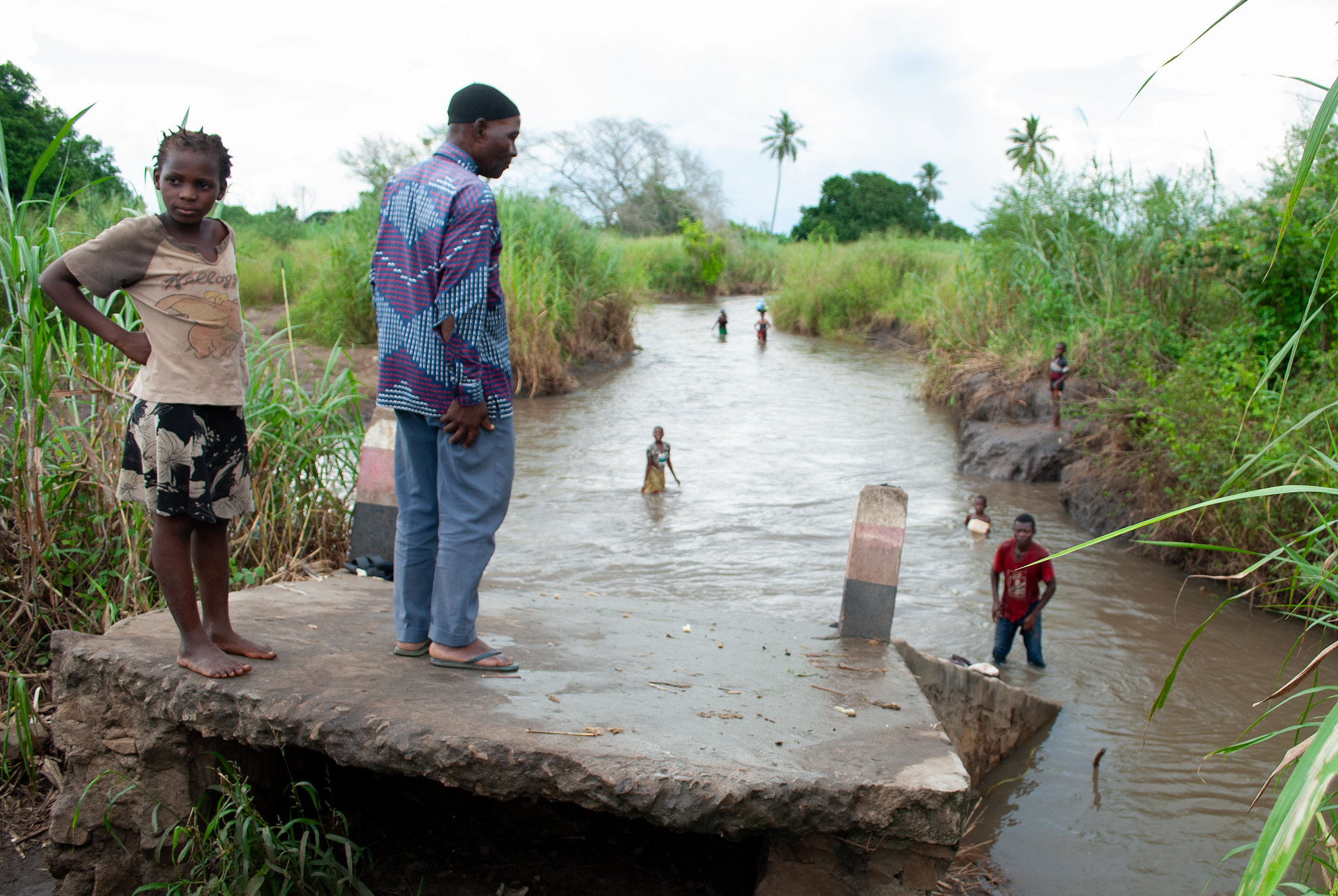
Community Bashiruna Bakar standing on a broken bridge near his village, 25 de
Junho. He is desperate to get a new bridge built, to allow farmers to travel more
easily from the village to their fields and back.
Since 2000, the Aga Khan Foundation has helped over 100 communities establish their own VDOs across northern Mozambique, covering Cabo Delgado, Nampula and Niassa provinces. Starting with a grant of 38,000 Meticals (£430), these bodies thereafter sustain themselves. Some lack capacity or commitment. But many flourish.
Another CSO in Mozambique called MASC adopts the same approach. It supports 30 VDOs and 80 women’s saving’s groups around the country. ‘There’s a magic to these groups,’ says MASC’s representative in Cabo Delgado, Návia Glória. ‘They differ in age, culture and geographic area, but they work.’
During my time in Cabo Delgado, I learn that, rather than replacing local authorities, good CSOs become their extension. They form a collaborative dynamic. As Manuel Teodoro, a Metuge district official, says: ‘The VDOs are the right hand of the local government.’
In other countries, equally ‘networked’ CSOs pursue a similar model. The Rural Support Programme Network in Pakistan or BRAC in Bangladesh are two examples of CSOs whose community-centred approach became so effective that their number multiplied over the years, ultimately forming national programmes.
‘It is often CSOs who are closest to communities, who understand the nuances of poverty, exclusion, and opportunity, and who remain when projects end and headlines fade,’ states Lisa Kurbiel, Director of the UN’s Joint Sustainable Development Goals Fund. Kurbiel believes these CSOs catalyse development when embedded within supportive financial and political structures.
With many governments across the Global South stretched and donor budgets shrinking fast, international partners should trust such CSOs, offering flexible, long-term financing. These small investments respond to political concerns like insurgency and displacement. For years, donors have talked the talk on localisation. Now, like Bakar and his village, it’s time to walk the walk.
A version of this article was first published in The Independent on Thursday 16 April.


Thank you harryjohnstone for this good analysis ! So important to raise awareness for these pressing issues of our time. A heartfelt THANK YOU also the Aga Khan Foundation for their ongoing efforts.