A crisis of “Western” reason?

harryeyres's avatarharryeyres

The usual hand-wringing – including the hand-wringing of this blog – about the Brexit vote and the election of Donald Trump on a ticket with disturbing echoes of the 1920s and 1930s only goes so far. I’ve been thinking in recent days and weeks that we need, or at least I need, to go further into this, to see it as not just a political crisis, a crisis of democracy, but as a philosophical crisis, a crisis of reason.

Let me sketch out roughly what I mean. Both the EU as currently constituted and interpreted and the Democrat programme in the US as exemplified by Hillary Clinton are essentially technocratic, managerial projects with little ethical or transformative substance. True, and this is important to me even if not to some critics of this blog, both enshrine certain principles with regard to lack of discrimination, minority rights, environmental protection, adherence to…

View original post 600 more words

Hunger Shames

A comparative book review:

THE END OF PLENTY – The race to feed a crowded world, by Joel K. Bourne

THE REPROACH OF HUNGER – Food, justice, and money in the twenty-first century, by David Rieff

Joel K. Bourne considers a world seemingly destined for even more hungry people. The planet’s human population is expected to reach 9 billion by 2050. Food production increases are barely able to match population increases. Food stocks are diminishing. The extraordinary growth of food production brought about by the “Green Revolution” since the 1960s is now levelling out due to soil nutrient depletion, a result of the intensive farming that was deemed necessary to address unprecedented global population growth. The increasing consumption of meat and dairy products, which requires and releases more carbon dioxide to produce, is exacerbating climate change. Climate change is already reducing production for farmers throughout the world.

It makes for scary reading. Bourne is happy to furnish our fears. He writes, “The world’s farmers face a . . . Herculean, task: to double grain, meat, and biofuel production on fewer acres with fewer farmers, less water, higher temperatures and more frequent droughts, floods and heat waves. And they must do it without destroying the forests, oceans, soils, pollinators, or climate on which all life depends. It is the biggest collective hurdle humanity has ever faced”. Later he adds,  “we’re on a roller coaster that has just left the tracks”.

This catastrophic scenario is relieved somewhat by the book’s narrative structure. Bourne eases our worries with stories of ingenious and personable farmers doing their bit to help themselves and, implicitly, humanity.

Bourne has a passion for seeds and soil. He admires people working the land, none more so than the father of the “Green Revolution”, Norman Borlaug. He describes an “iconic” image of Borlaug in a Mexican field in 1964: “His shirtsleeves are rolled high, revealing a brawny, sun-darkened right arm that scribbles in a large notebook . . . his eyes steeled on the wheat field in front of him, judging its height, vigor and yield.” Borlaug is one of many heroic figures in this story. Other hopeful characters include: a maverick American aquaculturist off the coast of Panama, an Ivy League microirrigation engineer launching his start-up in India, and corporate farmers in Ukraine looking to exploit the potential of Europe’s breadbasket.

The End of Plenty is both readable and compelling as a series of largely apolitical tales of farmers’ challenges and triumphs set against the wider environmental context.

Yet The End of Plenty does not go far enough, both in terms of analysis or prescription. As its subtitle states, this book is about “the race to feed a crowded world”. But Bourne sees the problem of hunger narrowly, as largely one of food supply, and suggests answers mainly in agricultural innovation alone.

This tendency to see the solution to global hunger through “innovative” agricultural development is the view of the “mainstream”, as David Rieff makes clear in The Reproach of Hunger: Food, justice, and money in the twenty-first century. The mainstream comprises all the major players apparently aiming to tackle hunger: the United Nations, bilateral aid agencies such as USAID and DFID, the Bill and Melinda Gates Foundation, Jeffrey Sachs, the World Bank, international NGOs and even agro-industrial multinationals. Reiff argues that they share a misguided “faith” that hunger can be eradicated – for that is their aim – through “smart aid”, scientific innovation and “best practices” drawn from the private sector.

Rieff correctly asserts that this mainstream development consensus represents an ideology that simplifies the causes of hunger and underestimates the scale of the changes required to tackle it. He argues that “hope has become the default of our age, and realism . . . is now widely considered to be a moral solecism and almost a betrayal of what it should mean to be a compassionate human being.” He laments this status quo, “in which good intentions are too often conflated with good deeds and good deeds with effective ones”. He deplores “an age where it is a fact and not an opinion that inequality is deepening across the world, that power and wealth are more and more concentrated in the hands of the tiny minority of the world’s population, and that politics even in democratic countries is increasingly unresponsive”. He concludes that “all this talk about individuals making a difference [is] at best a consoling farce”.

The Reproach of Hunger is a long, rambling book filled with long, rambling sentences. But Rieff’s insight on the illusory quality of the development consensus is important. As is his assertion that hunger is fundamentally a political problem, not a technical one. But Rieff, like Bourne, fails to offer an alternative. His overriding scepticism precludes it. Disconsolate, he agrees with the philosopher John Gray that the “emancipation of market forces from social and political control” represents the only revolution currently underway.

These books – one fearful, the other despairing – offer divergent visions of the challenges we face in feeding the “bottom billion”. Bourne fears we may not produce enough food considering existing farming methods, population growth and the effects of climate change, while Rieff doubts that “philanthrocapitalism” – the present approach – offers a real solution. Yet they struggle with the same binary: either working with, or against, capitalism. Neither ventures a credible political alternative.

Alternatives do exist, however. As with water, we must defend the aim of “enough food for all” from the vicissitudes of market economics. As a norm and an ideal, ending hunger should be a cross-party political goal. This should be safeguarded legally, by enshrining rights within all state constitutions. Governments that breach their citizens’ “right to food” should be liable.


The Times Literary Supplement


The Curdled and Uncurdled Latte

harryeyres's avatarharryeyres

The sky which was clear blue an hour ago is now milky. The last couple of days here in London we’ve had bright sun with even a hint of warmth in it, after the long although not very wintry winter, and that lovely fresh smell I associate with early spring, my birthtime. I’m in a cafe with my latte (I refuse to call it a flat white), pondering. I’m pondering especially the remark by my reader Joan-Eric Torrent questioning whether it’s right to enjoy these pleasures of ease and relative affluence while so many are suffering. “That thought curdles my latte,” he wrote. My reply to him was that we have to begin though not end with ourselves and we will not be able to radiate or communicate much well-being or joy if we are too immersed in our own suffering. That was what I learned, with greater or lesser success, from…

View original post 194 more words

Mali’s Prospects for Peace

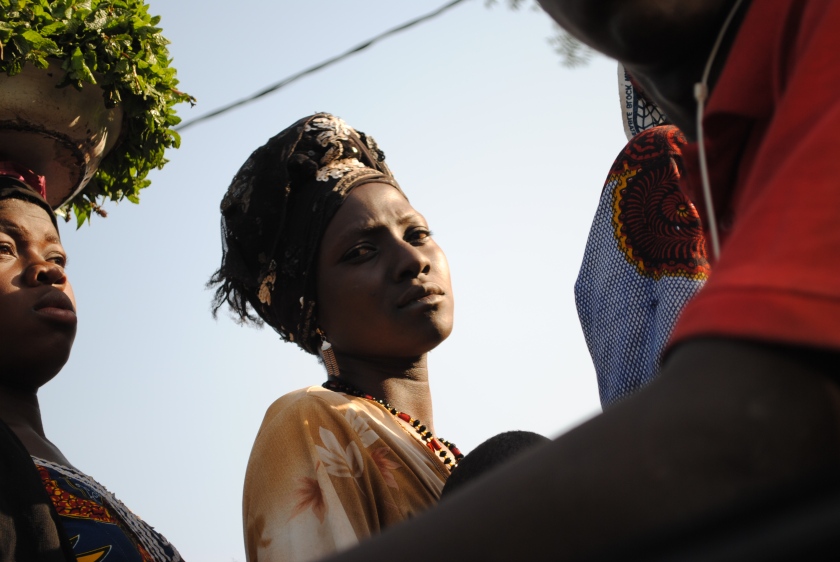
Bamako woman.jpg

The attack on the Radisson Blu hotel in Bamako on 20 November was symptomatic of Mali’s protracted social conflict. Twenty-one people were killed during the day-long siege, including the two jihadists from Al-Mourabitoun, one of several radical Muslim factions operating in the north of the country. A recurring conflict between northern Tuareg actors and the government has also plagued Mali since it gained independence in 1960. In 2012, the ‘fifth Tuareg uprising’ and almost simultaneous jihadist attacks broke out across the north, expelling government forces from Timbuktu, Kidal and Gao regions. These parallel movements threatened Mali’s state sovereignty, prompting French military and UN peacekeeping interventions as well as an internationally mediated peace process. Three years later, it remains to be seen whether lasting peace can be achieved in Mali.

In the short term, successive French military interventions Serval and Barkhane have weakened northern radical Islamic militant groups such as Ansar Dine, which led the 2012 jihad, and al-Qaeda in the Islamic Maghreb (AQIM). The French army recently reported that between July 2014 and 2015 Operation Barkhane had removed 125 terrorists from Mali and seized 20 tonnes of munitions. The UN peacekeeping force (MINUSMA) has also helped to stabilise the conflict, despite recently becoming the fourth-deadliest mission in the history of the blue helmets. In addition, Mali’s neighbouring states coordinate to tackle security challenges as part of the Nouakchott Process, which started in late 2014. These initiatives have de-escalated the conflict for now.

The peace process has also made some advances in conflict transformation between 2014 and 2015. The large number of northern armed actors were united in their hostility towards a Malian state they saw as exclusionary and corrupt, but splintered over goals and methods. By July 2014, the mediation team, led by Algeria, had successfully coalesced the actors into two coalitions – the more statist, government-leaning Platform, and the more secessionist Coordination des mouvements de l’Azawad(known as ‘Coordination’) – which became compliant within a political process. By the time the Coordination signed the ‘Algiers Accord’ on 20 June 2015, the process had achieved notable compromises among parties. For example, the Coordination dropped its goal of a separate ‘Azawad’ territory and agreed to back a single, secular Malian state. The government also shifted its position, agreeing to the official use of the name ‘Azawad’ for the northeastern region, and several additional political concessions.

Significantly, the Accord offers considerable devolution to northern Tuareg populations represented by the Coordination. It also promises economic investment in the north, which both the Platform and the Coordination desire. Meanwhile, both northern factions have agreed to disarmament, demobilisation, reintegration and reinsertion (DDRR), including merging some elements into the national security forces. Socially, the Truth, Justice and Reconciliation Committee, which aims to investigate violence and abuses committed in the country during 1960–2013, is an important step towards fostering a culture of reconciliation.

The peace deal also generated a positive international response, with France pledging €360 million in reconstruction assistance on 21 October. The following day the Organisation for Economic Co-operation and Development (OECD) hosted an international conference on Mali, to solicit further investment from the public and private sectors. The meeting concluded by stating that Mali requires some €3.5 billion in humanitarian and development assistance during the next six years.

All of these initiatives are de-escalating conflict in Mali. But the question remains whether they are actually transforming the conflict. Three developments in 2015 would suggest not. Firstly, the Coordination refused to sign the Algiers Accord when the Platform did so in March, because, among other unmet aspirations, the group rejected the proposed security arrangements. This rejection was almost certainly based on concerns that its forces would not be stationed optimally when ‘guarding’ northern roads. Secondly, both the Platform and the Coordination broke the ceasefire agreement, central to the Accord, several times between May and September, halting the implementation of the peace deal. Each breach was a result of armed elements moving into ‘forbidden’ territories in the northern regions. Their objective, again, was to claim key strategic roads when, through the Accord, they would soon be entrusted to ‘police’ them. This manoeuvring led to several clashes, the last of which, on 17 September, resulted in 15 fatalities. Following this ‘mutually hurting stalemate’, the third key event was a three-week long meeting in Anefis between the Platform and the Coordination, which ended in mid-October with a deal to end hostilities. According to reports, this so-called ‘pact of honour’ again centred around cantonments along the northern roads.

Both parties’ concerns over the control of roads in the north is explained by the prevalence of smuggling in the area. Illicit trade across Mali’s northern border has grown since the 1970s – from cigarettes, to cannabis, to cocaine, heroin, arms and human beings – and has become a vital source of revenue for northern communities. Controlling roads heading into Algeria guarantees vital income through bribery and kickbacks. A worrying associated trend has been kidnapping, particularly by terrorist networks seeking cash for the release of hostages.

The fact that so much of the peace process has, in effect, hinged on control over trafficking routes reveals two key insights: firstly, that criminality and corruption is endemic both in the north, but also reputedly in Bamako, massively undermining Mali’s long-term governance and security. Secondly, that people engaged in such activities seek this income for themselves and their communities, revealing the persistent poverty and deprivation of the north, which is still resource-poor and economically marginalised. As Paul Collier has forcefully argued, this kind of poverty is a key driver of conflict. Both insights suggest that the structurally rooted nature of conflict in Mali persists, despite efforts at delivering peace.

For real conflict transformation in Mali to occur, northern criminality needs to be tackled by force, but also through strengthened governance and rule of law. Broader recognition of the problem is necessary: Mali’s diplomatic community still treats cross-border trafficking as a taboo; radical ‘Islamists’ or tribal dynamics are instead seen as the key drivers of conflict. The Nouakchott Declaration refers to transnational trafficking networks merely in passing. Donors should force Bamako to tackle the issue by disinvesting, for example, when trafficking indicators are triggered. The UN Office for Drugs and Crime (UNODC) remains weak in Mali. International organisations must be capable of confronting corruption at the central level.

But in parallel with such efforts, the international community must support the government in promoting legitimate forms of income to replace this criminal economy. France’s financial pledge is undoubtedly important, but it remains a ‘pledge’, only €80 million of which was dedicated to the north. The government must honour its commitments, enshrined in the Algiers Accord, to northern political and economic integration. Moreover, the international community must incentivise this assimilation into the national economy by promoting existing assets, like tourism, and identifying alternate revenue streams. In this way, the northern groups can be legitimately empowered, in conflict analysis terms, so as to be able to negotiate effectively with the government within an ongoing political process.

As long as trafficking and criminality are allowed to continue, and no viable alternative exists, then this war economy will prevail throughout northern Mali. In this context, armed actors will continue to rise against the state. And jihadi ‘spoilers’ will continue to kidnap and kill, as they did in Bamako on 20 November. As such, Mali’s prospects for peace remain worryingly remote.

International Institute for Strategic Studies

 

Joseph Cornell

It’s hard to know where to begin, reviewing this Joseph Cornell exhibition. There are so many themes, ideas, and fascinating paradoxes running through his work. Cornell’s objects and assemblages – recalling sixteenth-century Wunderkammer (Cabinets of Curiosity) – are endlessly surprising, curious and intriguing.

Initially there’s that flea market feeling; what you experience among antiques and bric-a-brac, the gazing over ephemera. But soon you start to glimpse the depth and grasp of Cornell’s art.

In Cornell’s world we traverse eras, from ancient Egypt to Renaissance Italy to New York City in the 20th century. We see moonscapes and spectral nights. We marvel over exotic birds and ballerinas. We are captivated by the imagination, and the imagination is captured, and framed, in cases and cabinets.

Cornell is the archetype of an urban solitary, a flaneur of the 20th century. Despite his poor upbringing, living most of his life with his mother and disabled brother in a clapboard house in Flushing, Queens, he was able to satisfy his immense curiosity by visiting the public library, museums, bookstores and junk shops – places that could be visited by anyone. In these places he escaped. Then later he would return, to the kitchen of his house, to ply together his poetic fantasies, his visions of wonder.

And what visions they are. Early on in the exhibition we get a measure of Cornell’s early surrealist aesthetic, his perfectionism, and the attention to minutae. In Soap Bubble Set (1941), we see a box with a black background. There is a pipe, with wooden stem and ceramic white chamber blowing “bubbles” – a cluster of glass discs – within which are x-ray images of white shells. It is intricate, startling and suggestive, evoking transience; momentary and deep time framed together.

JC PharmacyLater we see Pharmacy (1943), a glass cabinet that resembles other works from the exhibition in sharing the same grid form. Cornell’s piece was referenced by Damien Hirst in his enormous Pharmacy installation produced fifty years later. Hirst used his piece to question belief in science over art. But whereas Hirst’s installation is clinical, presenting lots of clean shelves of medicine packets, Cornell’s little case contains misty glass bottles, which enclose crêpe and tissue cuttings, translucent crystals, a paper butterfly wing, golden paint, copper and sulphate. Unlike Hirst’s piece, which speaks blandly to a single abstract idea, there’s an intrinsic appeal, a tangible and personal quality to Cornell’s work.

Cornell reveled in the idea of discovery and travel. Works contain old 19th century maps and cut up pages of Baedeker, the Victorians’ guide book of choice. Cornell stunned Marcel Duchamp with his knowledge of Paris’ streets, despite never having visited the city. His box Naples (1942) uses a sepia photograph of a Neapolitan street as its backdrop with a local wine glass, shell and tag labeled ‘Naples’ dangling suggestively within the glass.

Cornell’s Habitat Group for a Shooting Gallery (1943) reveals the artist’s passion for parrots.JC Shooting Gallery There’s a taxonomic aspect to
this box, as the colourful birds are numbered.  Yet the birds and the bare backdrop are splodged with paint drops. These were designed to represent bullets and blood. Deeply troubled by the war, the piece suggests how our Enlightenment ideals of discovery and learning were messed up by the idiocy of war.

JC Towards BlueTowards the end of the show we see his memorial box for Emily Dickinson, Toward the Blue Peninsula (1953). It was inspired by the Amhurst bedroom where the American wrote her poetry. Cornell’s box is all white, partly caged, with a window looking onto a blue sky. It’s a sympathetic metaphor for Dickinson’s life. Both Dickinson and Cornell were introverted artists who travelled little. Both, however, were fervent believers in the world outside.

One of the last pieces that struck me was Hölderlin Object (1944-46) in which a small wooden box encases a book set beneath a sheet of blue glass. The book is wrapped in what appears as cobalt blue velvet, tied up with a lighter blue string. Embedded in the box’s lid is a large blue oak leaf, a traditional symbol of power, majesty and the German nation. It is a symbolic homage to the great German Romantic poet Friedrich Hölderlin. The blue glass brings a mysterious otherworldly quality to the work, a sense of what Hölderlin would have called Sehnsucht, or longing.

Throughout Cornell’s work we sense nostalgia, “the light of other days”, as he called it. As the world war raged and a standardizing Fordism exploded across America, Cornell yearned for elsewhere – for the dancer Tamara Toumanova, for the grace of historical figures, for flights unto the stars, for moonlit nights. His art was escapist, child-like, humble. Out of the great tragedies of the last century, he created a world that saw wondrous beauty in small things, and for that he was essentially optimistic.

The Joseph Cornell exhibition at the Royal Academy, “Wanderlust”, ran from 4 July – 27 September 2015.

Womad

As someone who lives in Rome, where the sun shines most days and people usually wear clothes that look fine, and they eat good food with wines that complement each other, I had moments at Womad music festival where I thought to myself ‘If your average Italian was to find themselves here, they really would think the English are an eccentric bunch!’

On a blustery Saturday afternoon, in the “World of Well-Being” area, I saw a sixty-something year-old grey-haired woman wearing a hemp, rainbow-coloured elves hat. She was walking past a Tibetan yurt, which was installed next to another tent which contained devices that seemed to stretch people, by hanging them from their feet. This was supposed to be relaxing.

On a freezing Sunday morning, after three hours of continuous rain, I saw a woman in her thirties, trudging barefoot, ankle-deep, in a huge pool of muddy water. This pond had emerged next to a large L-shaped line of green portaloos. She was navigating through, holding her Birkenstocks in one hand. Her face was disgusted, contorted against the diagonal drizzle. She looked utterly miserable. What on earth are they thinking, the Italian might ask?

My answer would be the music. WOMAD has always had among the most talented musicians, producers and singers on earth coming its way.  This year was no exception. Hip-hop legends De La Soul had crowds nodding to their funky beats. South Sudanese duo Acholi Machon made gentle political statements at the wooded Ecotricity stage. Tiken Jah Fakoly performed with his usual gusto and guts – singing about the injustice of a world where Africans cannot enter European countries but Europeans can travel and live anywhere they want in Africa. The Music of William Onyeabor, the headline act, had everyone dancing and smiling to their electronic soul and disco vibes.

Rain or shine, WOMAD is consistently the most diverse music festival in Britain. Everything else – the mung bean soups and shiatsu healing centres –  is secondary.

Womad music festival takes place every July in Charlton Park, Malmesbury.

Baroque in Rome

Review of the exhibition at the Palazzo Cipolla

As someone who has lived in Rome on and off over the past seven years, I found this exhibition on the Baroque in Rome particularly enjoyable. It helped me gain a greater understanding of this city whose history is so woven into the surfaces of its streets and squares, the facades of its buildings and their interiors.

The sculpture, paintings and architecture of the 17th century form some of Rome’s most characteristic sights. The Piazza Navona, for example, was transformed during this time. The Palazzo Pamphilj, the Church of Sant’Agnese and the Fountain of the Four Rivers, comprising the piazza’s most dramatic architecture, were all either completely re-designed or constructed at the height of the Baroque period. All are found within the same photo taken by millions of tourists each year.

My reference to photography is deliberate. These tourists are unwittingly perpetuating a practice that was heavily pursued through works of Reni, da Cortona, Rubens and Bernini: the dramatic potential of capturing the moment. This was one of the key ideas of the Baroque movement.

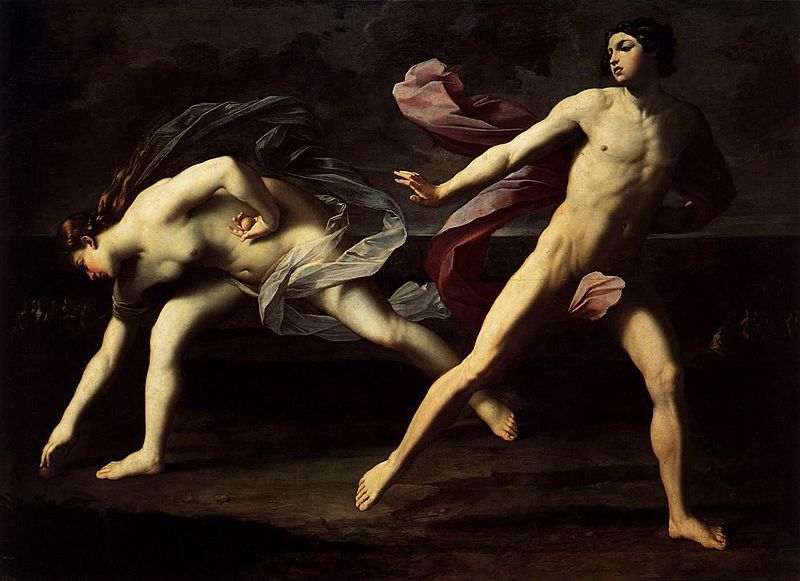
File:Guido Reni - Atalanta and Hippomenes - WGA19271.jpg

The drama of the moment is paramount throughout the exhibition at the Palazzo Cipolla. In the first room we stand before energetic scenes such as Guido Reni’s Atlanta and Hippomenes, floundering mid-race, yet frozen in time. Reni depicts the image with extraordinary grace: the protagonists’ skin and shadows are softly rendered yet prominent against the dark backdrop. Through the angles of their limbs, the artist cleverly carries the viewer’s eye in an arc across the canvas.

But above all we see biblical stories reflected dramatically through the Baroque art on display. Da Cortona’s Angels Scaling the Foreheads of the Children of Israel, for example, is viewed from the surface of the sea, at night, a confused sight of angels flying above the boats that contain the children of Israel, marking crosses upon the desperate passengers’ foreheads. The painting represents a vision of the Apocalypse, with the division of risen souls on the Day of Judgment. The chaotic scene is illuminated by a glowing crucifix held aloft by an angel.

Another sensational moment is captured by the Bolognese sculptor Alessandro Algardi with his bronze statuette, Saint Michael Overcoming the Devil. Saint Michael, sporting feathered wings, stands over the Devil. His right arm is raised. His left holds a chain fixed to a manacle that clasps the arm of the devil that is in flames beneath, writhing, mouth and eyes open, frantic.

Baroque artists were encouraged to captivate their audiences. They were expected to capture all the drama of the Christian narrative in order to draw crowds into the churches that fell under the papal domain. Politics demanded it. Luther’s damning theological critique of Catholicism provoked the Council of Trent, which led to the Counter Reformation. Consequently, art had to persuade: it invoked drama, magnificence and the intense spiritual expression of Caravaggio.

Together, this movement created what the art historian Robert Hughes has described as “the last great universal language of spirituality”. This language can be clearly understood at the Palazzo Cipolla exhibition.

Catholic Herald

The Tyranny of Experts

“It is time at last for the debate that never happened to happen. It is time at last for the silence on unequal rights for rich and poor to end. It is time at last for all men and women to be equally free.” Thus ends The Tyranny of Experts, William Easterley’s latest insightful book about international development.

Since the early 20th century, and after World War II, argues Easterley, the architects and managers of international aid – governments and “experts” – have unanimously favoured an apolitical approach to development that attempts to achieve economic growth through centralized, technocratic means.

Through this “blank slate” vision of development these “experts” have neglected the rights of poor people. As a result, they have actually undermined poor people’s prospects for greater material wealth over the long term. Easterley suggests that the racist colonial belief in poor people’s inability to think for themselves is sustained through mainstream development practice today.

The Tyranny of Experts draws heavily on the ideas of 20th century Nobel prize-winning economist and philosopher Friedrich Hayek. One of Hayek’s most popular books, The Road to Serfdom, challenged the wisdom of top-down central planning. Easterley takes his cue, arguing that development should be achieved via what Hayek described as “spontaneous order” rather than the “conscious design” favoured by Hayek’s contemporary, Gunnar Myrdal, and successive generations of development economists.

Easterley invokes Adam Smith’s notion of the ‘invisible hand’ of the market to illustrate how individuals seek opportunities within complex systems when incentives exist. Easterley wants the “experts” to focus more on creating these incentives by pushing for poor people to be granted their political and economic rights. These rights are intrinsically good, he argues, plus they help individuals pursue the market opportunities that will ultimately lead to national growth. He uses the phenomenal success of South Korean car giant, Hyundai, founded by Chung Ju Yung, to make his point.

Unfortunately, the latter half of the book is problematic. Easterley uses too many threads of research simultaneously, including a continuous reference to the history of Greene Street, New York, as a weakly conceived example of how “spontaneous solutions” triumph over central planning.

Though it loses some coherence, The Tyranny of Experts nonetheless compels us to re-examine the purpose and methods of international aid.

Bullfighting


bullfight

Ten days ago I watched a ‘bullfight’ in Jerez. We were there during the Feria. At the time, it was hard to process the experience of watching a bull slowly killed by a small group of men on a sandy floor.

The crowd are elegant. They wear suits and ties and elegant floral dresses. Those who sit in the sun have fans. People drink sherry out of small glasses. They applaud when the bull comes lumbering out.

It charges out of the gate. The first thing one notices is how much muscle it possesses. The whole body is rippling; the haunches creased with muscle that wobbles over his back. You notice its size. Most of the them are more compact, lower to the ground, than you’d expect. But they move fast. And stupidly. They have no expression. Dumb, is the word. They look around confused. They reach the edge of the circular ground. A man with a pink cape gets the bull’s attention. It moves towards him with trite gusto.

The ease  with which the man moves away from the bull makes one pity the bull immediately. We’re smiling at our superiority from the start. The picadors emerge. They weaken the bull. The armoured man on the protected horse emerges. He plunges a spear into the bull for ten seconds. He twists the spear in deep. The bull now is severely weakened. No longer does he run with gusto. He’s breathing deeply. His stomach contracts and expands greatly with each deep breath.

The picadors spring balletically towards it and plant decorated pins onto the arch of the bull’s neck. Blood seeps down his neck. The toredor spins the bull around him, to the joy of the crowd. The bull’s stomach is now wrenching fast.

Eventually he plunges a sword deep into a spot on the bull’s neck. I assume it carries through to the bull’s heart. If he misses the spot, the bulls stays alive. When this happens the crowd whistle. They do not approve of this. It is unfair to the bull! It is bad sportsmanship.

To me this ‘show’ of mercy to the bull seems absurd. The animal never had a chance in the first place. There’s no logic to their thinking. Sure, by hitting the spot you assure a less painful, drawn-out death. But you’re wounding the bull throughout its time in the stadium with the initial spearing and the pins.

The toredor eventually kills the bull. The crowd cheers. The bull lies on its side, tongue dangling. Sometimes its feet twitch as it dies. Horses come in with chains to drag the bull away. The trailing body leaves a smooth wide line over the sand as it is dragged towards the pen. Its feet remain taught. The banality of death.

I almost cried at times during the six fights we watched. The killing of animals was of course shocking in itself. But it would be hypocritical to oppose it while I eat meat, slaughtered in factories.

What is disturbing is we are paying to be entertained by the killing of animals. I looked across to examine the faces of the crowd and felt very alone and somewhat afraid. Like how I could feel sometimes on a dance floor when lots of people are on drugs.

And in a sense, what I was watching was the same. A kind of mass hypnosis. A sense that since others are there, participating, it’s ok. And my fears about human weakness came to the fore. Our hypocrisy. Our stupidity. The apparent ease with which we can legitimise something in numbers. Weakness in numbers.


Globalization And Its Discontents

I have just read Joseph Stiglitz’s Globalization and Its Discontents (2002).

Stiglitz was the Chief Economist at the World Bank and Chairman of President Clinton’s Council for Economic Advisors. He won the Nobel prize for Economics in 2001.

He has formidable expertise and experience and has succeeded in writing a book about economics that is both readable and compelling.

His basic argument runs that the International Monetary Fund (IMF), the international economic institution responsible for supporting countries facing economic crisis, was largely responsible for the failure of globalization in the 1990s.

The IMF, states Stiglitz, continuously adopted an out-dated and dogmatic adherence to market fundamentalism – the belief in letting the free market deliver economic stability and growth. Their policy to achieve this, in East Asia and Russia, was incoherent and went against the basic tenets of Keynesian economics.

The IMF’s failed policy prescriptions included fiscal austerity, high interest rates, rapid trade liberalization, liberalizing capital markets and privatization.The IMF’s institutional “fear of default” also comes in for criticism.

I enjoyed this book though I found the focus a little too narrow; it rarely deviates from its specific critique of the IMF. Surely other players should come into consideration if you intend to address the failings of a phenomenon as broad as globalization? Only the World Trade Organization, the U.S. Government and the World Bank, are addressed in this context.

The “behind the scenes” actions of corporations and foreign governments in influencing policy are ignored. Here Stiglitz misses an important trick. I would also have liked to see more analysis of how poor economic decisions directly affected people in these developing countries; the repercussions of, for example, liberalization policies were often enumerated only very vaguely.

Stiglitz undoubtedly succeeds in revealing the impudence and irresponsibility of the IMF’s interventions in developing countries. But I wonder how else it could operate? The “international bureaucrats” to which he so often refers must work according to very tight timelines. Sometimes these seemingly mundane factors help to explain their lack of flexibility or foresight.

But it’s nevertheless shocking to learn how much the IMF is governed by the narrow interests of the Western financial community, whose investments are recouped via the multi-billion dollar cash injections into these developing economies, while their poor lose their jobs and livelihoods and the middle classes foot the tax bill that ensues.